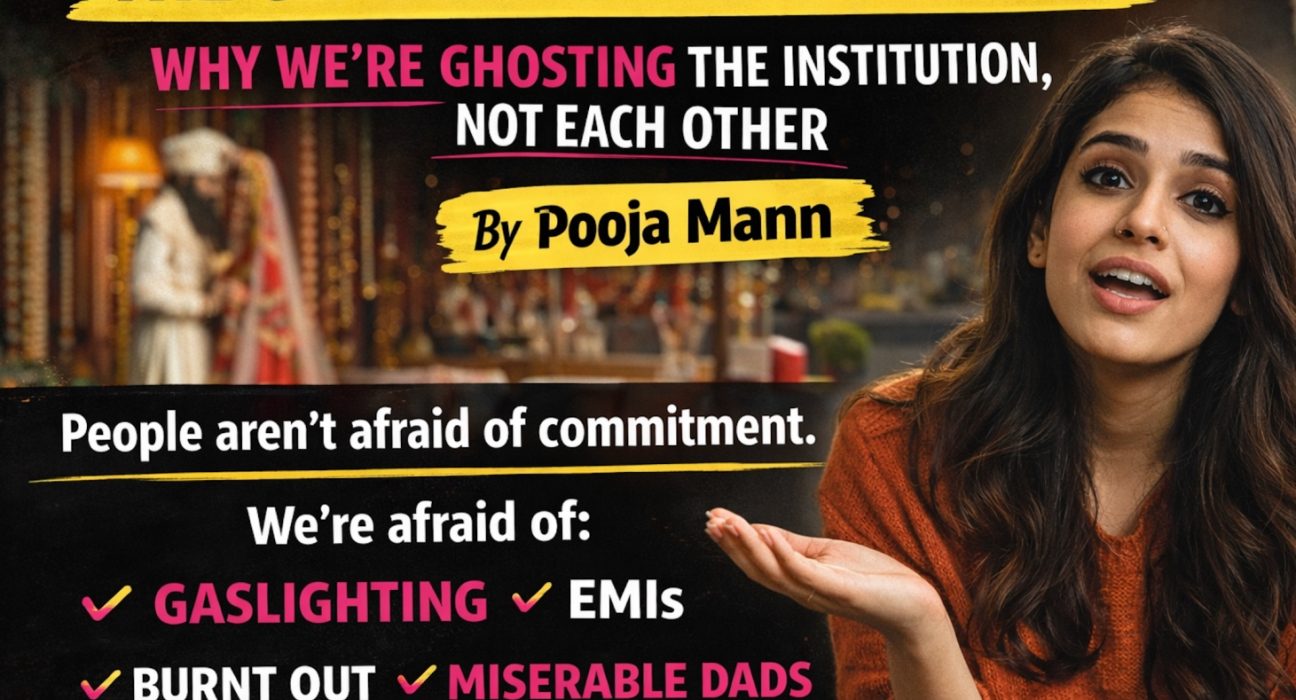
By Pooja Mann
(Blogger. Observer. Survivor of “So, when are you getting married?” conversations.)
Let’s address the elephant in the room.
Actually, forget the elephant—there’s a whole wedding procession missing.
Marriages are declining.
Not just in India. Not just in the West.
Globally. Across cultures. Across religions. Across generations.
And before anyone says, “Kids these days don’t value commitment”—please sit down, sip some water, and read till the end.
Because commitment isn’t dead.
Blind commitment is.
The Numbers Don’t Lie (But They Do Make Aunties Nervous)
Facts first, because emotions come later:
- Marriage rates have dropped sharply in the US, Europe, East Asia, and urban India.
- People are marrying later—or not at all.
- Divorce rates rose… then plateaued… because fewer people are entering marriages in the first place.
- Live-in relationships, long-term partnerships, and “we’re together but not legally trapped” setups are rising.
So no, people haven’t stopped loving.
They’ve stopped signing lifetime contracts without exit clauses.
Every Generation Before Us: “Adjust Kar Lo”
Let’s rewind.
Our grandparents married because:
- Society said so
- Families decided so
- Love was optional
- Survival was mandatory
Our parents married because:
- Stability mattered
- Divorce was taboo
- Emotional needs were… negotiable
- Therapy was called “keeping quiet”
And our generation?
We watched all of this.
We saw:
- Silent marriages
- Loud arguments behind closed doors
- Women shrinking
- Men emotionally unavailable
- Children learning conflict avoidance as a life skill
And then elders ask:
“Why don’t you want to get married?”
Sir. Ma’am. Exhibit A is your marriage.
Reason #1: We’re Too Aware for Our Own Good
Earlier generations didn’t have:
- Relationship podcasts
- Therapy reels at 2 a.m.
- Financial independence spreadsheets
We do.
We know what emotional labor is.
We know what gaslighting is.
We know what bare minimum looks like.
We know that “He doesn’t hit you” is not a compliment.
Ignorance helped marriages survive.
Awareness is making us ask better questions.
Reason #2: Women Are No Longer Economically Trapped
This one makes people uncomfortable—so let’s lean into it.
Earlier:
Marriage = financial security
Now:
Marriage = optional lifestyle choice
When women earn, own, decide, travel, invest, and live alone:
They don’t need marriage.
They choose it—or they don’t.
And when choice enters the room,
compulsion quietly leaves.
Reason #3: Marriage Hasn’t Updated Its Software
Let’s be honest.
Marriage as an institution is still running on:
- Patriarchy OS 1.0
- Gender roles from 1950
- Expectations without instructions
- Vows without accountability clauses
But modern relationships require:
- Emotional intelligence
- Shared chores
- Consent
- Growth
- Therapy (sometimes individual, sometimes joint, sometimes just self)
Marriage didn’t die.
It just failed to evolve fast enough.
Reason #4: We’re Tired, Broke, and Emotionally Burnt
Romantic weddings are cute.
EMIs are not.
Today’s generation is juggling:
- Inflation
- Career instability
- Hustle culture
- Mental health issues
- Burnout disguised as ambition
Love is still desired.
But lifelong responsibility?
Only if it adds peace—not pressure.
Reason #5: We’ve Seen That Love Alone Is Not Enough
This is the biggest lie sold to us.
Love without:
- Respect
- Communication
- Compatibility
- Shared values
- Emotional safety
…is just attachment with better marketing.
We are not anti-love.
We are anti-suffering-in-the-name-of-love.
So What’s the Solution? Should We “Fix” This?
Here’s the uncomfortable truth:
There is no problem to fix.
Marriage declining is not a crisis.
Unhappy marriages were.
Maybe marriage shouldn’t be the default.
Maybe companionship can look different.
Maybe staying single is not failure.
Maybe choosing peace over pressure is maturity.
And maybe—just maybe—
marriage will survive only when it becomes:
- Equal
- Flexible
- Emotionally safe
- Optional
Not mandatory.
Not glorified.
Not forced.
Final, Blunt Thought (Brace Yourself)
Marriage is not dying.
Bad marriages are.
And if that scares society—
good.
Because the generation that questions
is the generation that heals.
Signed,
Pooja Mann
Voice of a generation that chooses happiness
—even if it makes family WhatsApp groups uncomfortable.